If you’re living in Buenos Aires, you’ve undoubtedly felt a shift in the air since early June 2026. The passing of Carlos “Indio” Solari, the iconic frontman of Patricio Rey y sus Redonditos de Ricota, at 77 on June 5, 2026, sparked widespread national mourning across Argentina and among the diaspora. For newcomers, this moment offers a unique window into the soul of a nation, showcasing how deeply Argentines connect with their cultural heroes and how music truly unifies this often-divided country.
Los Redondos & Indio Solari: A Cultural Overview
Patricio Rey y sus Redonditos de Ricota — affectionately known as Los Redondos — was more than just a rock band. Formed in La Plata in 1976 and active until 2001, they became a cultural phenomenon due to their fiercely independent ethos, poetic lyrics, and “Ricotero masses” (misas ricoteras) that drew hundreds of thousands of fans. Indio Solari’s death on June 5, 2026, after a long battle with Parkinson’s, is a collective moment of grief and a powerful reminder of the band’s enduring legacy in shaping Argentine identity and community.
Indio Solari’s Passing and the Wave of National Mourning (June 2026)
The news hit hard on June 5, 2026: Carlos “Indio” Solari, “El Indio” to millions, had passed away at 77 following a hemorrhagic stroke and Parkinson’s disease. As of June 2026, Buenos Aires and the entire country entered a period of profound mourning. You might have seen spontaneous public vigils or memorial gatherings downtown, with people coming together to share their grief and celebrate his life. As one expat described it, despite some political undertones, it was a “beautiful experience” to “commune with my peers out there,” highlighting the immediate and visceral sense of collective emotion that few events can stir in Argentina.
Just weeks before his passing, in May 2026, the University of Buenos Aires recognized Solari’s immense cultural impact by awarding him an honorary doctorate (Honoris Causa), a testament to his profound contribution to national identity.
Patricio Rey y sus Redonditos de Ricota: Roots of an Anti-Establishment Legend
To understand the depth of feeling, you need to know Los Redondos. Officially Patricio Rey y sus Redonditos de Ricota, the band formed in La Plata in 1976 — a critical time in Argentine history as the military dictatorship was taking hold. Their music offered a space of artistic and psychedelic resistance during those repressive years, becoming a symbol of liberation as the country transitioned to democracy.
What truly set them apart was their unwavering artistic independence. Los Redondos operated entirely outside traditional music industry structures. They rarely gave interviews, rejected corporate sponsorships, and self-produced their albums, preferring direct connection with their fans. This anti-establishment ethos — “they never sold out to the record companies” — is often compared to the philosophy of American counter-culture icons like the Grateful Dead, making it perhaps more relatable for an international audience. The band was active until 2001, leaving behind a discography that continues to shape Argentine rock.
“Misas Ricoteras”: More Than Just Concerts
The core of Los Redondos’ legacy lies in their live shows, affectionately known as “Ricotero masses” (misas ricoteras) or “secular pilgrimages.” These weren’t just concerts; they were massive communal gatherings, fostering a unique sense of identity and brotherhood. From the 1990s onward, these events drew crowds that sometimes exceeded 300,000 people. Imagine the energy of the “pogo más grande del mundo” (the world’s biggest mosh pit), a legendary collective dance that symbolized the unity and passion of their fanbase.
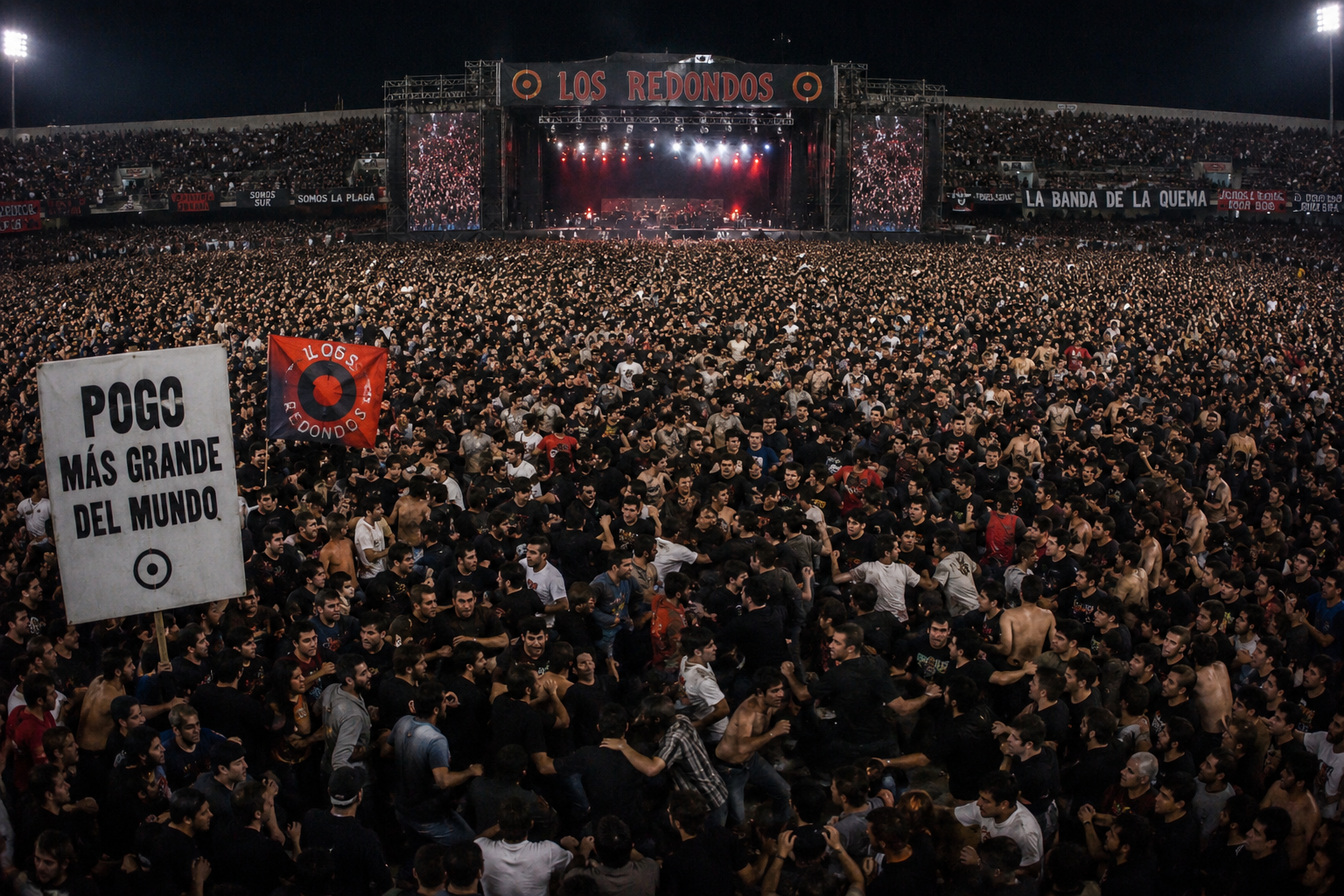
A vast crowd participating in a “pogo más grande del mundo” at a Los Redondos concert
This deep devotion echoes the sentiment associated with the Grateful Dead, where fans would “camp out” for shows and feel like “one big giant family,” even referring to attending concerts as “going to church.” For “ricoteros,” these masses were a profound experience of “liberation” and “communion with your brotherhood,” especially powerful given the historical context of their emergence.
Poetic Lyrics, Political Resonance, and Unifying Power
Indio Solari’s lyrics were central to the band’s mystique. Often ambiguous, poetic, and critically sharp, they resonated deeply with fans, encouraging endless interpretation. They tackled complex themes pertinent to Argentina: the aftermath of the dictatorship, the impact of neoliberalism, and even drug culture. This depth and lyrical sophistication contributed to the band’s comparison to Peronism — not in political ideology, but in its significance as a widespread social and cultural phenomenon in Argentina.
In Argentina, music, alongside football (soccer), is one of the most powerful unifying forces. “Music… along with football are the two things that really bring Argentina together.” It can transcend everyday divisions, even political ones — because “it’s hard to be in Argentina and not talk politics.” This deep connection means that when a figure like Indio Solari passes, the country truly feels like “one country,” united in shared emotion and cultural identity.
Connecting with the ‘Ricotero’ Legacy Today in Buenos Aires
As an expat, understanding Los Redondos offers an invaluable insight into Argentine culture. You might not have been at a “masa ricotera,” but their legacy is everywhere. Here’s how you can connect with it:
-
Listen to the Music: Dive into their albums. Some classics include “Oktubre,” “Lobo Suelto, Cordero Atado,” and “Ultimo Bondi a Finisterre.” Pay attention to the poetic lyrics, even if you need a translation, and feel the raw energy.
-
Seek Out Tribute Bands: While the original band dissolved in 2001, and Indio Solari has passed, “tribute bands” (bandas tributo) frequently play in Buenos Aires venues, keeping the spirit alive. Check local event listings for upcoming shows.
-
Watch Documentaries: Several documentaries explore the band’s history and cultural impact. A good starting point can be “Indio Solari y la historia de Patricio Rey y sus Redonditos de Ricota” or “The Story of Patricio Rey and his Redonditos de Ricota” on YouTube to learn more about this phenomenon. Watch a documentary about Los Redondos here.
-
Engage with Locals: Ask your Argentine friends about Los Redondos. You’ll likely hear passionate stories and personal connections to the music. It’s a fantastic way to bridge cultural gaps and understand a piece of what truly makes Argentina, Argentina.
Key Dates and Facts at a Glance (As of June 2026)
-
Indio Solari’s Passing: June 5, 2026, at 77 years old. Nationwide mourning followed.
-
Los Redondos Formation: 1976 in La Plata.
-
Los Redondos Disbandment: 2001.
-
Max Concert Attendance (Indio Solari solo): Over 300,000 people.
-
Honorary Doctorate: Awarded to Indio Solari by the University of Buenos Aires in May 2026.
Cultural interpretations are subjective, and events & venues change. Always verify current event details. This content provides cultural insights and historical context; it is not a guide to purchasing event tickets or current concert schedules.
FAQ
What does “Ricotero” mean?
A “ricotero” is a dedicated fan of Patricio Rey y sus Redonditos de Ricota. The term signifies not just an appreciation for the music, but a shared identity, a sense of belonging to a large, passionate community, and an adherence to the band’s anti-establishment philosophy.
How did Los Redondos influence Argentine youth?
Los Redondos provided a voice for generations of Argentine youth, particularly during and after the military dictatorship. Their cryptic lyrics, anti-system stance, and massive, unifying concerts offered a sense of freedom, belonging, and a platform for expressing dissent and collective identity, far removed from mainstream commercialism.
Why is Los Redondos’ cultural impact compared to Peronism?
The comparison to Peronism, Argentina’s influential political movement, highlights the sheer scale and profound social impact of Los Redondos. Both phenomena transcended mere ideology or music; they cultivated immense popular devotion, created a strong collective identity, and inspired a unique subculture with its own symbols and rituals that permeated deeply into Argentine society.
Disclaimer: This post offers cultural and historical information and is not legal, immigration, or financial advice. Confirm all specific details with official sources. Prices, rates, and rules change rapidly — always verify information before making decisions.